How AquaLinks Built Award-Winning Water Monitoring with LoRaWAN and Datakubo
AquaLinks is an independent LoRaWAN installer based in Tortosa, Tarragona, Spain. They specialise in water monitoring for private shared-well communities — deploying and operating their own branded solution built on Datakubo's white-label IoT platform.
This is the story of how AquaLinks replaced the existing meters with 66 B Meters Hydrodigit-S1 LoRaWAN meters across two monitored zones in their first community and ended monthly site visits. AquaLinks now runs Datakubo in three private shared-well communities and more than 120 meters — the first, a second 39-meter community, and a third — and is onboarding more.
TL;DR
AquaLinks, an independent LoRaWAN installer in Spain, runs Datakubo as its white-label platform across private shared-well communities — under the AquaLinks brand, not Datakubo's. AquaLinks now runs the platform across three communities and more than 120 meters: a first community of 66 meters, a second of 39, and a third. In the first one, B Meters LoRaWAN meters replaced the existing units, every resident sees their consumption from their phone, and the community gets automatic leak alerts — the installation won Best Product at ExpoEbre 2025. Every community gets fully remote monitoring with no monthly site visits.
Last updated: June 15, 2026
66
Homes on shared-well metering
each resident sees their own consumption from their phone
0
Monthly site visits
fully remote monitoring from day one

Award · External Jury
Best Product — ExpoEbre 2025
The first community AquaLinks, an installer based in Tortosa (Tarragona), put on Datakubo won Best Product at ExpoEbre 2025. Not our claim — an independent jury's verdict.
What AquaLinks Installed
- 66 B Meters Hydrodigit-S1 LoRaWAN meters in the flagship community — existing meters replaced and upgraded to LoRaWAN-enabled Hydrodigit-S1 units
- A second community of 39 meters running on the same Datakubo deployment
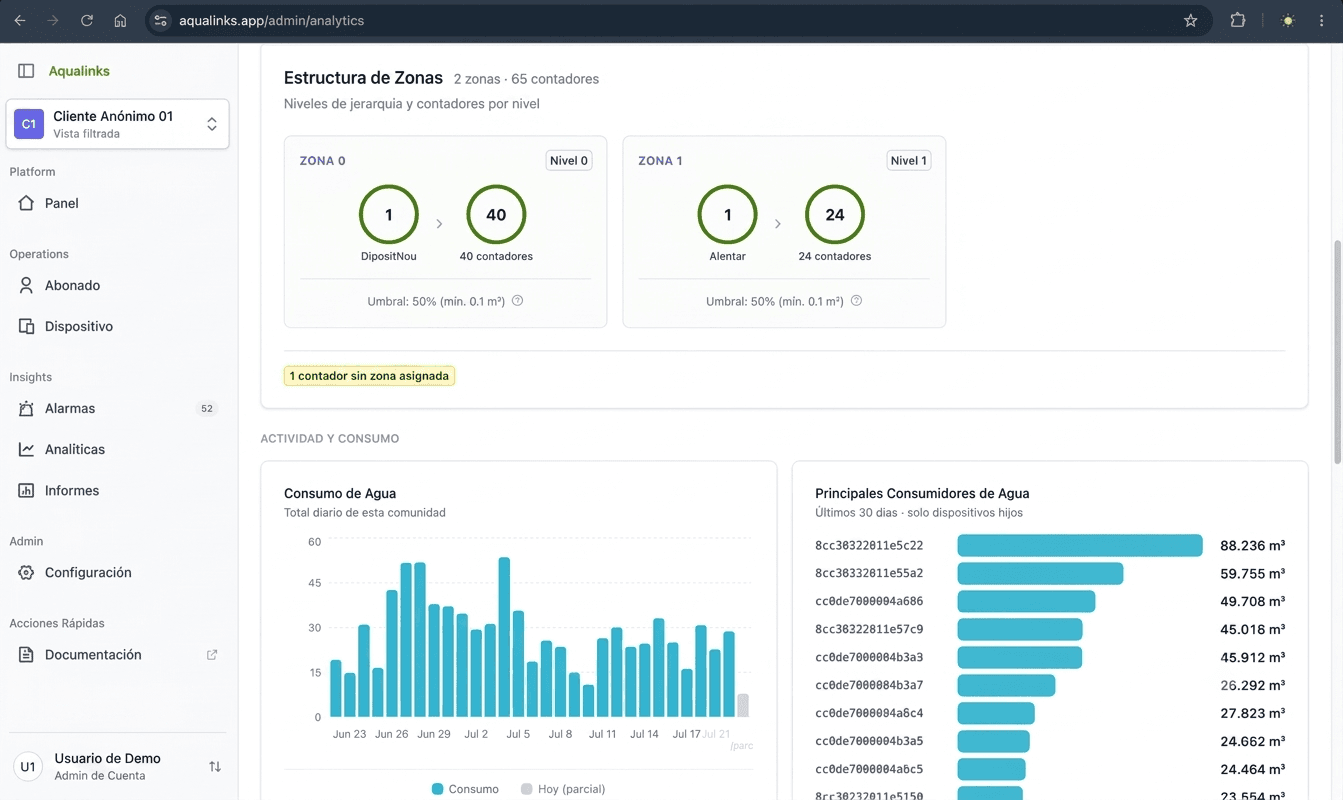
- Two monitored zones in a two-level hierarchy, so continuous-flow alerts pinpoint which part of the community a leak is in
- A private on-site TTN gateway plus The Things Network public infrastructure as a reliability fallback
- Datakubo as the white-label back-end platform, configured under the AquaLinks brand
- Per-household resident portals so each resident can log in and view their own consumption
Technology Stack
- Water Meters
- B Meters Hydrodigit-S1 LoRaWAN
- Network
- LoRaWAN
- Network Server
- The Things Network (TTN)
- Customer Portal
- Datakubo (white-label)
- Alerting
- Configurable continuous-flow detection (leak alerts)
- Coverage
- 3 communities, 120+ meters — 66 (first community, 2 zones) + 39 (second community) + a third
AquaLinks: LoRaWAN Water Monitoring in Tortosa, Tarragona
AquaLinks works with private shared-well communities and co-operatives across Spain where manual meter reading has been the default for decades. They install LoRaWAN water meters, configure the network, and give clients a branded monitoring portal — all under the AquaLinks name.
It began with one community and one goal: give a private well community real monitoring, alarming and reporting. Until then, members had no control over what was happening with their water — the only sign of trouble was an unusually high bill, and by then a leak had often been running for weeks.
Miguel, the founder of AquaLinks, looked at the IoT platforms on the market — Datacake, Ubidots, TagoIO and others. They were built for enterprise, with enterprise pricing to match, and there was no way to pass those costs on to a small community of residents. He also tried B Meters' own B Metering Cloud, but it only offered simple reporting — not the live monitoring, alarming and per-resident portals he was after. So he built his own monitoring system. It worked for that first community, but it was clear it would never scale as more communities came on board.
That is when Miguel turned to Xavier at Datakubo. The two already knew each other, and together they decided to build the platform with AquaLinks as Datakubo's founding customer — an independent reseller running its own branded solution on Datakubo's white-label IoT platform. AquaLinks keeps a hybrid LoRaWAN setup: a private on-site gateway handles most of the traffic, with The Things Network's public infrastructure as a reliability fallback at no added cost.
Today AquaLinks runs Datakubo across three private shared-well communities and more than 120 meters, and is onboarding more. As Miguel adds communities and features alongside a growing customer base, he and Xavier keep shaping the future of Datakubo together.
The Challenge: Manual Readings and Invisible Leaks
Before AquaLinks arrived, that first community relied on monthly meter readings done by hand. Members had no real-time visibility into their water use — the only clue that something was wrong was an unusually high water bill. By the time the cost showed up, a leak could have been running for weeks, sometimes through an entire billing cycle. Community managers had no tool to spot a meter running continuously or a household consuming far above average.
What Changed After Deployment
From the day the network went live, meter readings flowed into AquaLinks' branded Datakubo instance in real time. Residents logged into a portal branded as AquaLinks — not Datakubo — and saw their daily and hourly consumption for the first time.
Community managers stopped waiting for the monthly reading cycle. They now receive an automatic monthly report generated from live meter data — no site visit needed. If a meter shows continuous flow past a threshold set by AquaLinks, the platform flags a likely leak and sends an alert. What used to take weeks to discover is now caught in hours.
Each household has its own login and sees only their own data. Billing-ready consumption exports are one click away for the installer, with no manual data collection.
The Result: Live Consumption and Automatic Leak Alerts
In the first year of operation, AquaLinks' monitoring surfaced a leak in their first community that had been quietly driving consumption up — B Meters raised the alarm on its own, and Datakubo surfaced it in the portal the moment it arrived. Leaks that previously ran undetected for weeks were now caught within hours. Residents became more aware of their consumption once they could see real data from their phone, and billing disputes dropped because every figure was backed by timestamped meter readings. AquaLinks went from monthly manual visits to monitoring every community remotely — freeing up engineer time and improving service quality. The installation went on to win Best Product at ExpoEbre 2025.
The communities are satisfied with the monthly reports and instant leak alerts. They are now considering adding a physical alarm system to complement the platform notifications.
“I'd tried the big IoT platforms and even built my own, but nothing fit a small community's budget or scaled to more of them. Building Datakubo together with Xavier changed that — our customers see their own consumption, we catch leaks before they get expensive, and we keep shaping the platform as we grow.”
Before and After Datakubo
Before Datakubo
- Manual monthly meter readings
- Leaks discovered weeks later
- No visibility for residents
- Unbranded, technical tooling
- On-site visits to collect data
After Datakubo
- Live readings, updated automatically
- Leak alerts within hours
- Per-resident self-service portal
- White-label portal under the AquaLinks brand
- Fully remote monitoring across both zones
Results
- Customer portal deployed in under 1 hour
- Branded experience under aqualinks.app
- Leak detection alerts enabled across both monitored zones
- Customers access their own consumption data
- No custom software development required
- Best Product award at ExpoEbre 2025 — AquaLinks, Tortosa
How the Setup Works
Replace existing meters with B Meters LoRaWAN units
AquaLinks replaced the existing meters with B Meters LoRaWAN units. The new meters transmit readings directly over LoRaWAN — no additional pulse-counter module or gateway adaptor needed.
Connect the meters to the LoRaWAN network
Each meter joins the network via a private on-site TTN gateway, with The Things Network public infrastructure as a fallback for added reliability at no extra cost.
Point a TTN webhook at Datakubo and let the meters auto-register
The whole software setup takes under an hour. In Datakubo you generate an API key, add a TTN webhook that forwards uplinks to the Datakubo ingestion endpoint, and match your TTN application ID. From there it is hands-off — as each B Meters unit sends its first reading, Datakubo registers the meter automatically, with no manual data entry per device.
Datakubo delivers a branded client portal
Datakubo stores incoming readings and makes them available through a white-label portal branded as AquaLinks. Residents log in under the AquaLinks brand, see their meter data, and download consumption reports — without ever knowing Datakubo is the underlying infrastructure.
What AquaLinks Uses Today
- Real-time consumption dashboard showing live readings per meter
- Configurable continuous-flow detection — AquaLinks sets the threshold, the platform triggers the alert
- Automatic monthly consumption reports for community managers — no site visit required
- White-label client portal with AquaLinks branding and per-resident login
- One-click billing-ready consumption exports — no manual data collection